Get Back
If we have already lost much of the stillness required to just 'be', or to create art, just how much more are we willing to lose - how many books will be left unwritten, how many paintings won't be painted, how many Get Back’s will never be composed?
Hello everyone,
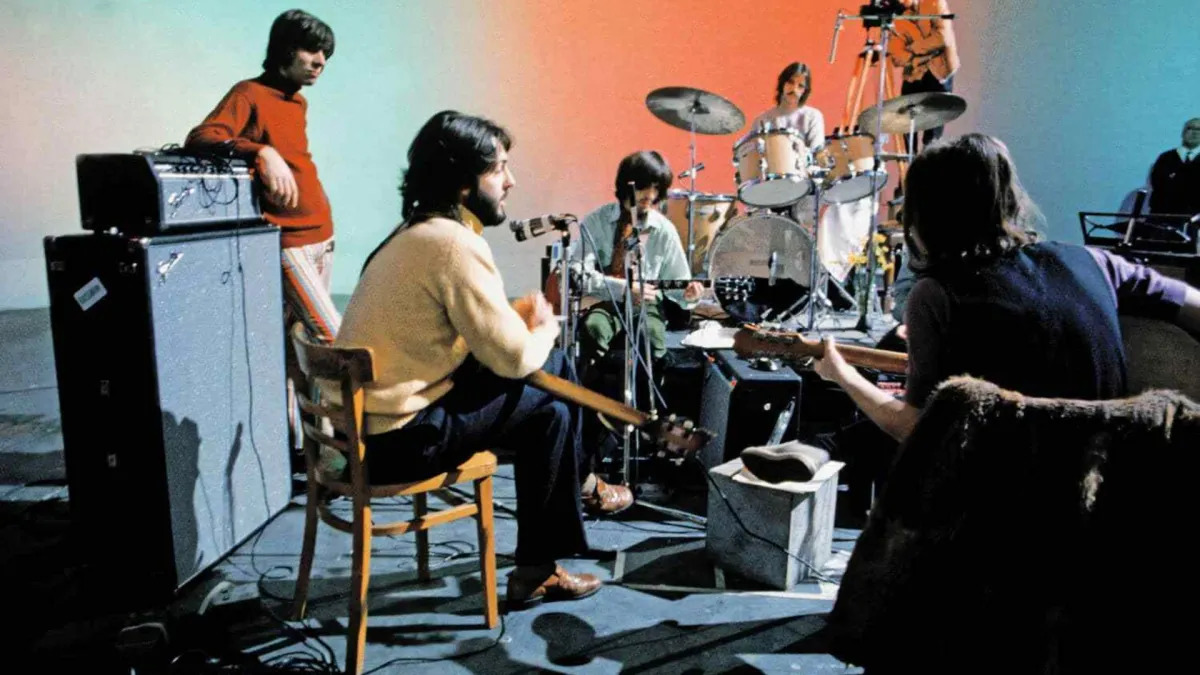
If you haven’t already seen Get Back, the 2021 Beatles documentary, produced and directed by Peter Jackson, you are in for a treat (many treats). With original footage from the 1969 Let it Be sessions beautifully remastered and restored, it offers an extraordinary insight into the creative process of the band, the ideas and personalities of each member and their relationships with one another. There are also great fashions to behold, in addition to many servings of tea, toast and buns. What more could one really ask for?
Amongst the many wonderful parts of this almost 8 hour production, there is a particularly touching scene where Ringo is listening to Paul play the piano and he says something so lovely along the lines of "I'd watch an hour of him just playing the piano, 'cause he's so great." In another scene, while waiting for John to arrive one morning, Ringo is again listening to Paul - this time he's playing the guitar - and Paul just happens to compose Get Back(!) But even if Paul’s playing came to nothing, these scenes would remain just as moving and tender - in the way that Ringo is simply ‘being’ with Paul.
Certainly, 1969 was a different time to now. Paul and Ringo did not have to contend with a slot machine in their pockets like we do. Plus, they had every need met in those studio sessions (all those buns didn’t butter themselves). And yet, if we were given these same conditions today, would we be able to simply ‘be’ like Ringo, or would we be compelled to do something else - to fill in that time?
We now spend our days in a state of continuous partial attention. Could we tolerate sitting on a stool, listening to our friend tinker on the piano? Could we focus long enough to compose a song? If we have already lost much of the stillness required to just 'be', or to create art, just how much more are we willing to lose - how many books will be left unwritten, how many paintings won't be painted, how many Get Back’s will never be composed?
It is not just the time to 'be' or the time to create that is lost either, but it is time with the muse, or, more specifically, time in which one is unoccupied so that the muse can pay us a visit.
Although a visit from the muse sounds romantic, elusive and mysterious (and it is), the muse will visit pretty much anyone. I only wrote The Flying Orchestra because the first lines, the first page, came to me in full when I was out on a walk one afternoon. I remember the exact street and place where it came to me too, so significant it seemed. Although I’d written and illustrated stories as a child, as a grown up person I’d never seriously considered writing and illustrating a book before that moment. Many artists will talk about the coming of ideas in a similar way. It seems as if the idea is not really yours, but rather, it comes fully formed and perfect, offering itself to you (of course, should you choose to accept the offering, then comes the more difficult work of bringing it out of the world of ideas and onto the page or stage or whatever the form is).
It was Paul McCartney himself who woke up one morning having dreamt the full melody of Yesterday so clearly, that he was sure it was someone else’s tune “…it was like finding a £10 note on the street” he said. Vincent Van Gogh, in one of his hundreds of letters to his brother Theo, wrote “I have a terrible clarity of mind at times, when nature is so lovely these days, and then I’m no longer aware of myself and the painting comes to me as if in a dream.” Emily Kam Kngwarray was said to sometimes finish one of her masterpieces (many of which are several metres long and wide) and walk off, almost without a second glance, so confident was she in the marks she put on paper, it was as if “the creation itself was the artwork”.
The world of dreams, our subconscious, when the mind is in a more meditative and receptive state (such as on a walk, daydreaming, creating, waiting for a train, or simply being) is the time the muse comes to us - but if we are always distracted in these moments - we miss important encounters - encounters with each other and encounters with the muse.
Of course, a visit from the muse is more rare and fleeting than it is to, for instance, receive a new text or email. But I would rather wait for this shy visitor, who may or may not come, than miss him altogether.
Writing Workshops WRITE15 for February
For a couple of years now I have been running online creative nonfiction writing workshops with Liza Cochran as part of our Understory Writers project. I believe so much in the transformative power of writing - and how important it is to have one's own creative practice. This 5 week course is for anyone from absolute beginners to those with a regular writing practice, and focuses on the natural world and our place in it. Our next course runs from the end of February to the end of March. All classes are taught online with a small group from all over the world (predominantly Australia, US and Singapore). We have had so many lovely students come through over these past few years and we'd love you to join us. We have a special offer for February for any friends/friends of friends. Enter WRITE15 on signing up for 15% off. Please do let me know if you have any questions. Scholarships are available.
(and please let me know if you would prefer to not receive these newsletters)
Love to all of you,
Clare
‘lanterna magica: the art of Emily Kam Kngwarray’ in Perkins, H., Green, J., & Cole, K. (2023). Emily Kam Kngwarray.
McCartney, P., & Muldoon, P. (2021). The lyrics : 1956 to the present.